

Search has changed dramatically. Voice assistants answer questions instantly. AI-powered search engines generate responses instead of just showing links. Local results dominate mobile searches.
If you’re a business owner, marketer, or SEO professional struggling to keep up with these shifts, you need a unified search optimization strategy that covers all the bases.
This complete guide breaks down the three essential pillars of modern search: Answer Engine
Optimization (AEO), Generative Engine Optimization (GEO), and traditional SEO. You’ll discover how to optimize for voice search and AI assistants that deliver instant answers. We’ll also dive into local search optimization tactics that help you capture customers in your area when they’re ready to buy. By the end, you’ll have a clear roadmap for integrating all three approaches into one powerful search visibility strategy that works across every platform and device your customers use.
Understanding the Three Pillars of Modern Search Optimization
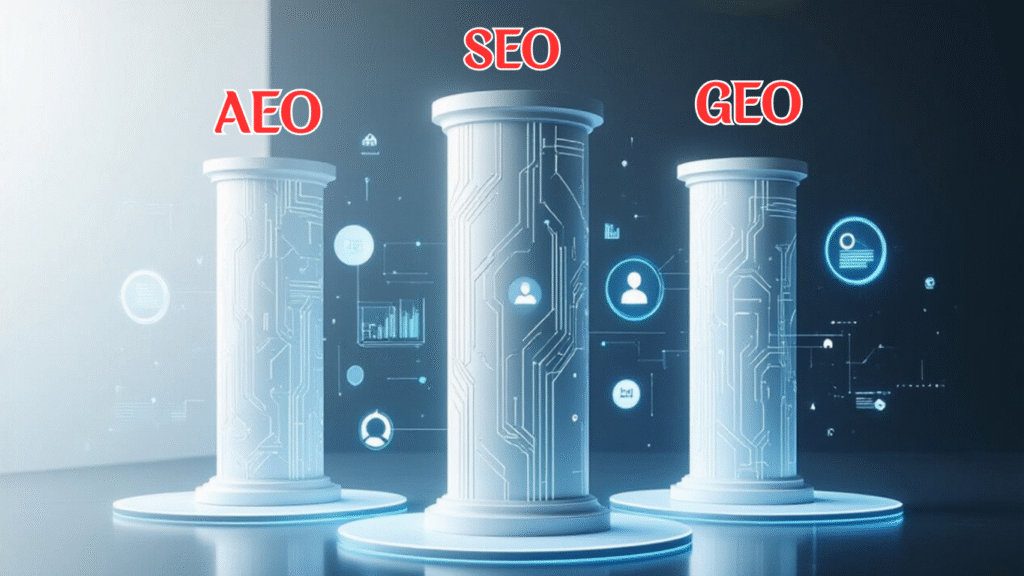
What AEO, GEO, and SEO Mean for Your Business
The search landscape has transformed dramatically, and businesses need to understand three critical optimization strategies to stay competitive. Search Engine Optimization (SEO) remains the foundation—it’s about making your website visible when people type queries into Google, Bing, or other search engines. You’re optimizing for traditional search results pages with keywords, content quality, and technical website factors.
Answer Engine Optimization (AEO) targets AI-powered search tools and voice assistants like Siri, Alexa, and ChatGPT. When someone asks “What’s the best Digital marketing institute near me?” to their smart speaker, AEO helps your business become the direct answer. This strategy focuses on providing clear, conversational responses that AI systems can easily understand and recommend.
Generative Engine Optimization (GEO) is the newest player, designed for AI systems that create comprehensive responses rather than just linking to websites. When someone asks Google’s Bard or Microsoft’s Copilot for restaurant recommendations, GEO ensures your business gets mentioned in those AI-generated responses.
Strategy | Primary Focus | Key Benefit |
SEO | Traditional search rankings | Website traffic and visibility |
AEO | Voice and AI search responses | Direct answers and recommendations |
GEO | AI-generated content mentions | Brand inclusion in AI responses |
Each strategy serves different user behaviours, and successful businesses deploy all three to capture the full spectrum of search opportunities
How Search Behaviour Has Evolved Beyond Traditional Keywords
Search behaviour has shifted from simple keyword matching to complex, conversational interactions. People no longer just type “pizza delivery”—they ask complete questions like “Where can I get gluten free pizza delivered before 9 PM tonight?” This evolution demands a fresh approach to search optimization.
Voice search optimization has become essential as smart speakers and mobile voice assistants handle billions of queries monthly. These searches tend to be longer, more conversational, and often location specific. People speak differently than they type, using natural language patterns that traditional SEO strategies often miss.
AI-powered search tools now interpret user intent rather than just matching keywords. Google’s AI understands context, synonyms, and even implied meanings. When someone searches for “natural ways to sleep better,” the AI recognizes they want health advice, not information about sleeping pills or mattresses.
The rise of zero-click searches means users often get their answers directly on search results pages without visiting any website. Featured snippets, local business panels, and AI-generated summaries provide immediate answers. This shift requires businesses to optimize for these direct answer formats, not just traditional link clicks.
Modern searchers also expect personalized results based on their location, search history, and preferences. A search for “best coffee” in Seattle will yield completely different results than the same search in Miami, even from the same user.
Why Multi-Channel Search Strategy Drives Better Results
Relying on a single search optimization approach leaves massive opportunities untapped. A unified strategy that combines Search Engine Optimization (SEO), Answer Engine Optimization (AEO), and Generative Engine Optimization (GEO) creates multiple touchpoints with potential customers across the entire search journey.
Consider a local restaurant as an example. Traditional Search Engine Optimization helps capture users searching on Google for phrases like “Italian restaurants downtown.” At the same time, Answer Engine Optimization ensures visibility when people ask voice assistants questions such as “What’s the best place for dinner near me?” Meanwhile, Generative Engine Optimization plays a critical role when AI-powered tools like ChatGPT or Google’s AI Overviews generate curated lists of local dining recommendations.
Search visibility improves significantly when all three optimization pillars work together. Different user groups rely on different search behaviors—young users often prefer voice search, professionals lean toward text-based searches, and business travelers frequently use AI assistants for fast recommendations. By aligning SEO, AEO, and GEO, businesses can reach each audience at the right moment.
Data consistently shows strong results for brands adopting modern, multi-channel search strategies:
Increased brand mentions: Businesses appear more frequently in AI-generated answers and voice responses
Higher conversion rates: Users discover brands through their preferred search format
Stronger local visibility: AEO-driven voice searches are highly location-focused
Future-ready positioning: GEO ensures visibility as generative AI becomes more dominant in search
Beyond visibility, this integrated approach provides deeper insights into customer behavior. Businesses can identify whether traditional search traffic, voice queries, or AI-generated recommendations drive the most qualified leads—and optimize their strategy accordingly.
Smart brands understand that Search Engine Optimization, Answer Engine Optimization, and Generative Engine Optimization are not separate tactics but interconnected systems. High-quality SEO content supports AEO by providing clear, structured answers, while local SEO data strengthens GEO by feeding accurate information into AI-driven search experiences. Together, these strategies create a resilient, adaptive search presence built for the future of discovery.
Mastering Answer Engine Optimization (AEO) for Voice and AI Search

Optimizing Content for Voice Search Queries
Voice search optimization is changing how people search online. Instead of typing short keywords, users now ask full questions like, “Which digital marketing agency can help my business grow?” This means businesses must go beyond traditional SEO and focus on answer engine optimization and generative engine optimization.
To succeed, content should use natural, conversational language. Voice searches are longer and often include words like who, what, where, when, why, and how. Using long-tail, spoken-style keywords helps search engines, voice assistants, and AI tools understand your content better.
Answer engine optimization works best when content gives clear, direct answers first, followed by short explanations. This makes it easier for search engines and AI systems to pull your content for voice results and featured answers. At the same time, generative engine optimization helps AI platforms recommend your business in summaries and suggestions.
Local searches are also growing fast. Combining SEO with voice search optimization, answer engine optimization, and generative engine optimization helps businesses appear for searches like “digital marketing agency near me” or “online marketing expert in my city.”
By using all three strategies together, businesses can stay visible in search results, voice searches, and AI-powered platforms—no matter how users search.
Structuring Data for Featured Snippets and Direct Answers
Featured snippets represent the holy grail of AEO optimization. These position-zero results appear
above traditional organic listings and often serve as sources for voice search responses.
Structure your content to answer specific questions within the first 40-50 words of a paragraph. Use clear, definitive language that search engines can easily extract. Avoid ambiguous phrases and get straight to the point.
Implement schema markup to help search engines understand your content structure. Use FAQ schema for question-and-answer content, HowTo schema for step-by-step processes, and Article schema for comprehensive guides. This structured data creates a direct pipeline between your content and AI search optimization systems.
Create content in multiple formats to capture different snippet types:
Paragraph snippets: Direct answers to specific questions
List snippets: Step-by-step instructions or ranked items
Table snippets: Comparisons, specifications, or data presentations
Use header tags strategically to create scannable content. H2 and H3 tags should pose questions or highlight key concepts that people commonly search for. This organization helps both users and search engines understand your content hierarchy.
Creating Conversational Content That AI Understands
AI-powered search engines excel at understanding context and user intent, but they need wellstructured, conversational content to work with. Write as if you’re explaining concepts to a knowledgeable friend rather than lecturing to a classroom.
Use active voice and simple sentence structures. AI systems process direct statements more effectively than complex, passive constructions. Instead of “The optimization process should be implemented by the marketing team,” write “The marketing team should implement the optimization process.”
Connect related concepts throughout your content using natural transitions. AI engines look for semantic relationships between ideas. When discussing answer engine optimization, naturally weave in related topics like user intent, search behavior, and content relevance.
Include variations of your target phrases using synonyms and related terms. AI systems understand semantic relationships, so mentioning “voice queries,” “spoken searches,” and “audio-based searches” alongside “voice search” strengthens your content’s relevance signals.
Address follow-up questions that typically arise after an initial query. If someone searches for information about AEO, they might next wonder about implementation costs, timeline, or required resources.
Anticipating these secondary questions creates comprehensive content that AI engines favor.
Measuring AEO Performance and User Engagement
Traditional SEO metrics only tell part of the AEO story. Voice search results don’t generate clicks in the traditional sense, requiring new measurement approaches to gauge success.
Track zero-click searches through Google Search Console. Look for queries where your content appears in featured snippets but generates minimal click-through traffic. High impressions with low clicks often indicate successful voice search optimization.
Monitor brand mention increases through social listening tools and Google Alerts. Voice search responses typically mention brand names when providing answers, leading to increased brand awareness even without direct website traffic.
Metric | Traditional SEO | AEO Focus |
Click-through rate | High importance | Medium importance |
Featured snippet captures | Medium importance | Critical importance |
Voice search rankings | Not tracked | Primary KPI |
Brand mentions | Low tracking | High tracking |
Local pack appearances | Important for local | Essential for voice |
Use tools like AnswerThePublic and SEMrush’s voice search features to identify question-based keywords you’re ranking for. These platforms reveal the conversational queries driving traffic to your site.
Set up custom Google Analytics events to track user behavior patterns from voice search traffic. Voice search users often exhibit different on-site behavior, typically showing higher bounce rates but stronger engagement when they do explore your site.
Regular content audits become crucial for maintaining AEO performance. Voice search algorithms update frequently, and content that performed well six months ago might need refreshing to maintain visibility in this rapidly evolving landscape.
Dominating Local Markets with Generative Engine Optimization (GEO)

Leveraging AI-Generated Content for Local Visibility
Creating content that resonates with AI systems requires understanding how generative engine optimization works at the local level. AI engines now pull information from multiple sources to craft responses about local businesses, making your content strategy crucial for visibility.
Start by developing location-specific content that addresses common customer questions. Instead of generic business descriptions, create detailed guides about your local area, industry-specific challenges in your region, and how your services solve neighborhood problems. For example, a plumbing company in Denver should create content about altitude-related pipe issues, while a restaurant in Miami might focus on hurricane-season food safety tips.
Structure your content using clear, scannable formats that AI can easily parse. Use bullet points, numbered lists, and headers that directly answer questions like “What makes [your business] different in [location]?” or “How does [your service] work in [city]?”
Local event coverage and community involvement stories perform exceptionally well with AI systems. When you sponsor a local charity run or participate in city council meetings, document these activities with rich, detailed content that establishes your business as an integral part of the community fabric.
Optimizing for Generative Search Results and Recommendations
AI search optimization for local businesses demands a different approach than traditional SEO.
Generative engines don’t just index your content—they interpret and restructure it to create new responses for users seeking local recommendations.
Focus on creating comprehensive comparison content that positions your business alongside competitors. AI systems love detailed breakdowns of services, pricing structures, and unique value propositions. Instead of simply stating “We’re the best,” provide specific metrics: “We complete 95% of residential repairs within 24 hours” or “Our customer satisfaction rate has remained above 98% for three consecutive years.”
Implement schema markup specifically designed for local businesses, including service area markup, review aggregation schema, and local business structured data. This helps AI engines understand your geographical relevance and service offerings more accurately.
Create FAQ sections that mirror actual customer conversations. AI engines frequently pull from these sections when generating recommendations. Your FAQs should sound natural and conversational, as if you’re chatting with a neighbor about your services.
Building Authority in AI-Powered Local Search Platforms
Establishing credibility with AI systems requires consistent signals across multiple touchpoints. Local SEO tactics now extend beyond traditional directories to include AI training data sources and usergenerated content platforms.
Customer reviews remain critical, but their role has evolved. AI engines analyze sentiment patterns, response quality, and review authenticity. Encourage customers to leave detailed reviews that mention specific services, staff members, and outcomes. A review saying “Great service!” carries less weight than “Mike diagnosed our AC problem in 20 minutes and had us cooling down within an hour.”
Develop partnerships with other local businesses to create cross-referential content. When the local hardware store mentions your contracting services in their how-to guides, or when you reference the neighborhood café in your project case studies, you’re building a web of local authority signals that AI systems recognize and value.
Authority Building Strategy | Implementation | AI Impact |
Customer testimonials | Video + text formats | High credibility scoring |
Local partnerships | Cross-promotional content | Network authority boost |
Community involvement | Event documentation | Local relevance signals |
Expert positioning | Industry guides + tips | Topical authority |
Regular content updates signal business activity and relevance to AI systems. Share project completions, new service offerings, seasonal tips, and community insights. The goal isn’t just to rank higher—it’s to become the default recommendation when AI engines generate local business suggestions for your industry and area.
Building Your SEO Foundation for Maximum Search Impact

Essential On-Page Optimization Techniques That Still Matter
Strong SEO foundations begin with mastering the fundamentals that search engines have relied on for years. Title tags remain your most powerful on-page signal, so craft them with your primary keywords while staying under 60 characters. Meta descriptions won’t directly boost rankings, but compelling descriptions that include relevant terms like “search engine optimization guide” can dramatically improve click-through rates.
Header structure creates the backbone of your content hierarchy. Use H1 tags for your main topic, then organize supporting points with H2 and H3 tags. This approach helps both traditional crawlers and AI systems understand your content’s flow and importance.
Internal linking connects your content ecosystem and distributes page authority throughout your site.
Link to related pages using descriptive anchor text that includes variations of your target keywords. When writing about modern search strategies, link to pages covering voice search optimization or local SEO tactics to create topical clusters.
Image optimization goes beyond simple alt text. Use descriptive file names, compress images for faster loading, and include relevant keywords naturally in alt attributes. This practice supports visual search while improving overall user experience.
URL structure should be clean and descriptive. Instead of generic parameters, use readable URLs that include your target keywords and clearly indicate the page’s purpose.
Technical SEO Best Practices for Modern Websites
Technical excellence forms the invisible foundation that enables all other optimization efforts to succeed.
Page speed directly impacts both user satisfaction and search rankings. Use tools like Google PageSpeed Insights to identify bottlenecks, compress images, minimize JavaScript, and leverage browser caching to achieve loading times under three seconds.
Mobile responsiveness isn’t optional anymore. Google’s mobile-first indexing means your site’s mobile version determines desktop rankings too. Test your site across different devices and screen sizes, ensuring buttons are easily tappable and content remains readable without zooming.
Core Web Vitals measure real user experience through three key metrics: Largest Contentful Paint, First Input Delay, and Cumulative Layout Shift. These metrics directly influence how search engines evaluate your site’s quality and user satisfaction.
SSL certificates and HTTPS protocols provide essential security that search engines now expect as standard. Sites without proper encryption face ranking penalties and browser warnings that scare away visitors.
XML sitemaps guide search engine crawlers through your content efficiently. Create separate sitemaps for different content types and submit them through Google Search Console to ensure comprehensive indexing.
Schema markup helps search engines understand your content’s context and meaning. Implement structured data for articles, products, reviews, and local business information to enhance search result appearance and support AI-powered search features.
Link Building Strategies That Support All Search Channels
Modern link building requires strategies that strengthen your presence across traditional search, voice queries, and AI-generated responses. Focus on earning links from authoritative sources within your industry rather than pursuing quantity over quality.
Content-driven outreach works best when you create genuinely valuable resources that other sites want to reference. Develop comprehensive guides, original research, or tools that naturally attract citations from industry publications and authoritative websites.
Local business partnerships create powerful link opportunities that support both traditional SEO and local search optimization. Collaborate with complementary businesses, sponsor local events, or participate in community initiatives that generate natural mentions and links.
Guest posting on relevant industry blogs helps establish topical authority while earning valuable backlinks. Choose publications that align with your expertise and audience, creating content that provides genuine value rather than obvious promotional material.
Digital PR campaigns can generate links while building brand awareness across multiple channels. Share newsworthy insights, comment on industry trends, or publish original research that journalists and bloggers want to reference.
Resource page inclusion offers another avenue for quality link acquisition. Identify pages that list helpful resources in your industry and reach out with suggestions for including your valuable content.
Content Creation That Serves SEO, AEO, and GEO Simultaneously
Creating unified search optimization content requires understanding how different search channels consume and present information. Structure your content to answer specific questions while providing comprehensive coverage of topics that support traditional search rankings.
Question-based content formats work exceptionally well for voice search optimization and answer engine optimization. Create FAQ sections, how-to guides, and step-by-step tutorials that directly address common user queries. Use conversational language that mirrors how people actually speak when using voice assistants.
Local content integration helps capture both traditional local search traffic and location-based voice queries. Include neighborhood names, local landmarks, and region-specific information naturally throughout your content while maintaining relevance to your broader topics.
Featured snippet optimization involves structuring content to capture position zero results. Use numbered lists, bullet points, and clear definitions that search engines can easily extract and display as quick answers.
Long-form content that covers topics comprehensively tends to perform well across all search channels. AI systems prefer detailed, authoritative content that thoroughly addresses user intent rather than superficial coverage of multiple topics.
Content clusters organized around pillar topics create topical authority that supports rankings across multiple search types. Link related articles together to demonstrate expertise and help both users and search engines understand your content relationships.
Regular content updates keep information fresh and relevant for evolving search algorithms. Schedule periodic reviews to update statistics, add new insights, and ensure accuracy across all your published content.
Integrating AEO, GEO, and SEO for Unified Search Success
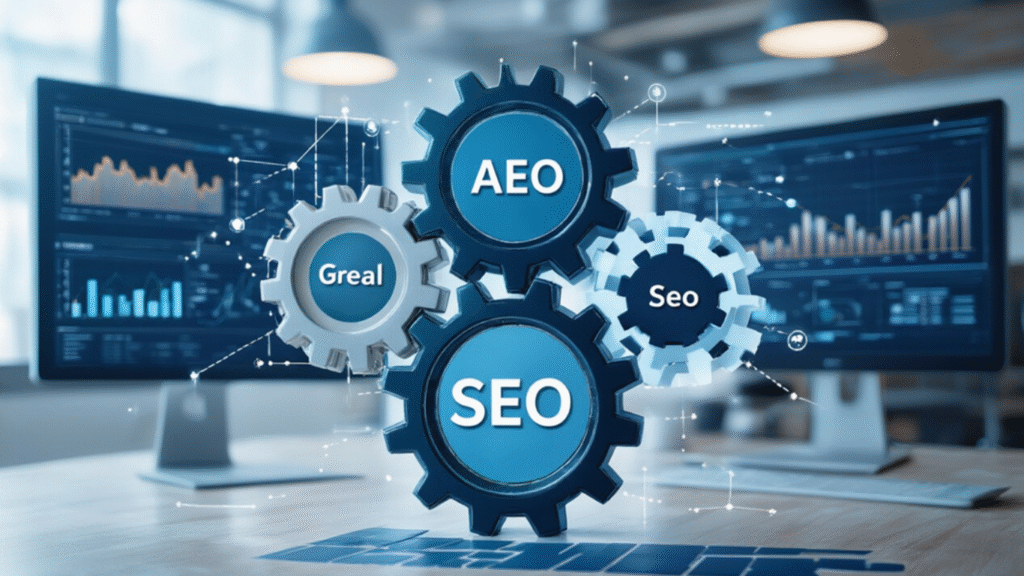
Creating Content Strategies That Work Across All Platforms
Building a unified search optimization strategy means your content needs to perform beautifully across traditional search engines, voice assistants, and AI-powered platforms. The key is creating content that naturally satisfies multiple search behaviours without feeling forced or repetitive.
Create content themes that cover the whole consumer journey first. Your material should surface in AI-generated responses, rank in local search results, and function for voice search when someone asks, “What’s the best Italian restaurant near me?” This means structuring your content with clear, conversational headings that mirror how people actually speak and search.
Focus on creating comprehensive resource pages that answer related questions in one place. Instead of writing separate pieces about “pizza delivery,” “Italian restaurant reviews,” and “romantic dinner spots,” create pillar content that covers the entire dining experience. This approach naturally supports voice search optimization while building authority for traditional SEO.
Your content should include:
Natural question-and-answer formats that voice assistants can easily parse.
Location-specific information woven naturally into the narrative.
Structured data markup that aids AI algorithms in comprehending the context of your content.
Conversational language that matches how people speak to voice devices.
The magic happens when you write for humans first, then optimize for machines. Your restaurant content should sound like a knowledgeable local friend making recommendations, not a robot listing features and benefits.
Tools and Analytics for Tracking Multi-Channel Performance
Measuring success across AEO optimization, GEO, and traditional SEO requires a diverse toolkit that captures performance data from multiple touchpoints. Google Analytics 4 provides the foundation, but you’ll need specialized tools to get the complete picture of your unified search optimization efforts.
For voice search and AI-powered search tracking, tools like AnswerThePublic and SEMrush’s Voice Search Analytics help identify the questions people ask and how your content performs in answer engines. These platforms reveal search patterns that traditional keyword tools miss, showing you exactly what voice queries drive traffic to your site.
Local search performance demands dedicated monitoring through Google Business Profile Insights, BrightLocal, and Moz Local. These tools track your visibility in local pack results, voice search responses, and AI-generated local recommendations. Pay special attention to metrics like:
Metric Type | Traditional SEO | Voice/AI Search | Local Search |
Primary KPI | Organic traffic | Featured snippet captures | Local pack rankings |
Secondary KPI | Keyword rankings | Voice query impressions | Review ratings |
User Behavior | Click-through rates | Answer satisfaction | Call-to-action completions |
Search Console data becomes even more valuable when segmented by device type and query characteristics. Long-tail, question-based queries often indicate voice search traffic, while locationmodified searches typically come from local search optimization efforts.
Set up custom dashboards that consolidate data from all platforms. This bird’s-eye view helps you spot trends and opportunities that might get lost when analyzing channels separately.
Prioritizing Efforts Based on Your Business Goals and Audience
Your resource allocation should align with where your audience actually searches and how they prefer to find information. E-commerce businesses might prioritize traditional SEO and AI search optimization, while local service providers should focus heavily on GEO and voice search optimization.
Start by analyzing your current traffic sources and customer behavior patterns. If 40% of your mobile traffic comes from voice searches, that’s where you should invest your time and budget. Look at your Google Analytics data to identify:
High-Priority Scenarios:
Local businesses with mobile-heavy traffic should emphasize voice search SEO and local optimization
B2B companies with research-focused audiences need strong traditional SEO and comprehensive answer content
E-commerce brands should balance product optimization across all three pillars
Resource Allocation Framework:
60% on your strongest channel – Double down on what’s already working
30% on your biggest opportunity – Invest in the channel with the most growth potential
10% on experimental tactics – Test emerging trends and platforms
Consider your competition’s approach too. If competitors dominate traditional search but ignore voice optimization, that’s your chance to capture market share in growing search channels. Use tools like Ahrefs and SEMrush to analyze competitor visibility across different search types.
Your audience’s demographics also drive priority decisions. Younger audiences use voice search more frequently, while older demographics might rely on traditional search methods. Business decisionmakers often research through multiple channels before making purchases, requiring a comprehensive approach across all modern search strategies.
Budget constraints require tough choices, but remember that many optimization tactics work across multiple channels. Quality content creation, schema markup implementation, and local business information management benefit all three search pillars simultaneously.

The digital search landscape has evolved far beyond traditional keyword optimization. Today’s successful businesses understand that AEO, GEO, and SEO work together as a powerful trio, each addressing different aspects of how people find and consume information online. Voice search and AI assistants demand AEO strategies that provide direct, conversational answers. Local businesses need GEO tactics to appear prominently in AI-generated local results. Meanwhile, classic SEO continues to form the bedrock that supports all other optimization efforts.
Smart marketers don’t pick just one approach – they blend all three for maximum impact. Start by strengthening your SEO foundation with quality content and technical optimization, then layer on AEO strategies for featured snippets and voice search. Add GEO techniques to capture local search traffic and AI-generated recommendations. This integrated approach ensures your business stays visible no matter how search technology continues to change. The future belongs to brands that can adapt to new search behaviors while maintaining strong fundamentals across all three optimization pillars.